Symbolic analysis of simplified Berton 2023 model
This session looks like nothing at all, but there was some interesting stuff going on here.
The idea
The idea here was to do some symbolic analysis of a simplified version of the Berton 2023 model to see if there might be a transition from the steady state to the oscillatory solution in the form of a Hopf bifurcation. This whole idea came out of a long chat with Claude, where I’ve been asking Opus 4.8 to look at the Berton 2023 model and another one, to get some idea of what I could do with it.
The whole process of doing this is kind of overwhelming: Opus is so very confident in everything it says, it can produce walls of algebra in seconds, and it looks superficially all very convincing. (This is obviously me getting my excuses in early. I didn’t spot the error that Opus made, even though it was pretty elementary.)
The lesson
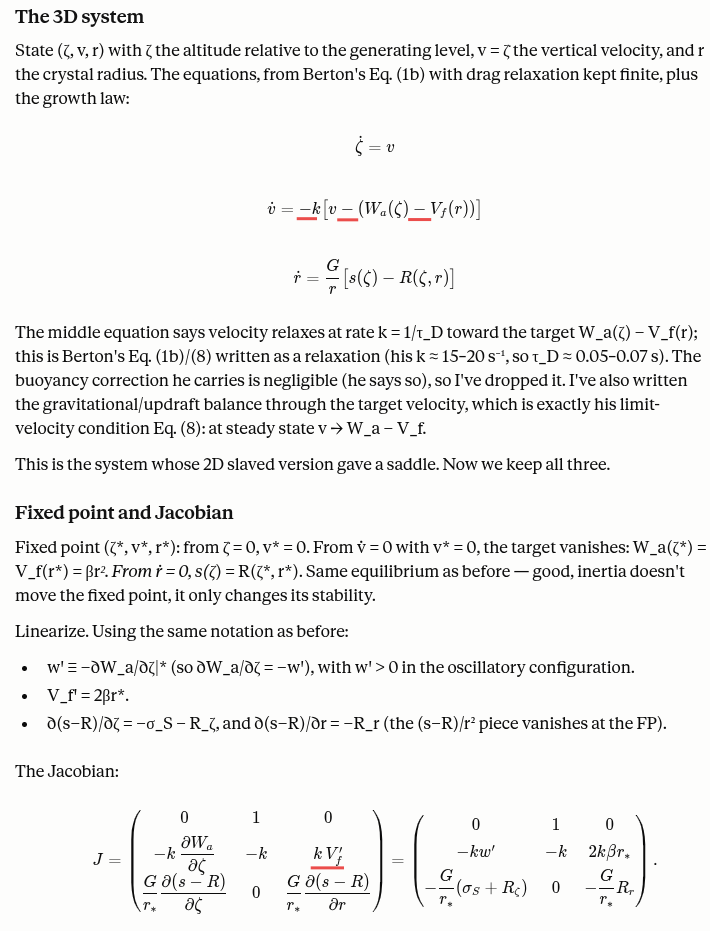
However (here’s the click bait), it turns out that, left to its own devices, Opus is not very good at algebra!!! It made a sign error in the calculation of the Jacobian of the simplified system, which completely tipped everything upside down. See the screen capture from Claude at the bottom, where three minus signs turn into zero minus signs, through the magic of LLMs…
The lesson here, and it’s one I probably needed to learn and that we all need to be aware of: do not trust an LLM to do algebraic manipulations. It’s as likely (or more likely) to make silly errors than you are yourself. The only difference is that it can make sign errors much more quickly than you can!
Doing it the right way
LLMs are better at writing code, so instead of getting Claude to do the algebra itself, I got it to write a project brief for an agent to implement the symbolic analysis in Python using Sympy. This is way more reliable and the analysis worked, producing a detailed report.
This is really another repetition of the “let the agent write code” point. It’s much easier for the agent to do that, producing a persistent artifact that can be run repeatedly and modified to improve it, than it is for the agent to “one shot” a calculation “by hand” (it really uses that phrase to describe its calculations in the chat, which is quite weird).
What survived into the research result
The scientific result is not that the reduced model proves Berton’s full model has a sustained oscillation. It does not. The result is more limited: once the Jacobian sign is corrected, the reduced fixed point is a stable spiral with a Hopf-capable sign structure. That made it a useful mechanism guide for the continuation work that followed.
The agent-process result is stronger and more general: do not ask an LLM to be a symbolic algebra engine. Ask it to build a reproducible algebra workflow, then inspect the executable artifact and the generated report.
In the next episode of this exciting story, I use continuation on the full Berton 2023 model to show that the approximation used in making the simplified model was too much of a simplification, and there isn’t convincing evidence for a robust Hopf bifurcation after all.
Opus does algebra